Accessories | Dogs
GPS vs Microchip for Dogs in Australia: Should You Get Both?
Lost a dog before? Then you already know the panic — and you already know what doesn’t help in that moment. The microchip in your dog’s shoulder blades is a permanent ID that gets your dog scanned and returned at the vet, the shelter, or the local council. It’s mandatory in most Aussie states for that reason. A GPS tracker is something else entirely — it actively pings the dog’s location to your phone so you can go and get them yourself. The microchip is the safety net. The GPS is the search party. They aren’t substitutes.
The Upshot
Don’t pick between them — your microchip is the law, the GPS is the rescue tool.
A microchip is passive ID that proves the dog is yours; a GPS tracker shows you where the dog is right now. They cover different failure modes. Microchipping is mandatory in most Aussie states for a reason — and a GPS tracker is what closes the recovery loop.
Best GPS Tracker

Tractive GPS Dog Tracker
- Real-time tracking, escape alerts
- Activity and sleep alerts
- Subscription required
See the full Product Guide: Best Dog GPS Collars with a Subscription
Best for Apple Users

Apple AirTag (4 Pack)
- One-year battery, no ongoing costs
- Works with the Find My app
- Not true GPS, needs iPhones
See the full Product Guide: Best Dog GPS Trackers with No Subscription

Most owners I talk to assume their microchip does more than it actually does. They think it tracks. It doesn’t. A microchip is a passive RFID tag — about the size of a grain of rice, sitting under the skin between the shoulder blades — that holds a unique number linked to your details in a registry. Someone needs to scan it with a reader. If your dog is on the loose three suburbs away, the chip is doing nothing for you until someone with a scanner finds them. That’s the whole point of a GPS tracker — to skip that step entirely.
We’ve fostered enough dogs through our place — and Pepper has slipped through enough back gates over the years — that we take this seriously. Both layers earn their keep for different reasons, and the worst time to learn the difference is at 9pm on a Tuesday with the back gate swinging. This guide breaks down what each one actually does, where each one falls short, and whether you really need both.
Quick Takeaways
The five things worth remembering. Scroll across to read all five.
Different jobs entirely
A microchip identifies who the dog belongs to. A GPS tracker shows where the dog is right now. Treating them as substitutes is how owners end up with neither layer working when it matters.
Chip is the law
Microchipping is mandatory for dogs in NSW, VIC, QLD, ACT and WA, usually by 12 weeks of age. Fines for skipping it run from $180 in NSW into the thousands depending on which state you’re in.
GPS does the finding
Cellular trackers like Tractive update your phone with the dog’s live location. Bluetooth tags like AirTags rely on nearby iPhones to ping a position back. Both beat searching the street on foot.
Layered safety
The proper setup is three layers: a collar tag with your phone number, a registered microchip, and a GPS tracker on the harness. Each one covers what the other two can’t.
Keep details current
An out-of-date microchip is functionally useless. Research from RSPCA Queensland shelters found 37% of stray-dog records had data problems. Update yours after any move or phone change.
What a microchip actually does
The technology is unglamorous and that’s the point. The chip itself is a 10–15mm sliver of glass containing an RFID transponder with a single 15-digit ID number. No battery. No GPS. No wireless connection until a handheld scanner activates it. A vet or council ranger waves a reader over the dog’s shoulders, the chip pings back its number, and the reader displays it. That number is then looked up in whichever Australian registry holds the dog’s record, and the owner’s contact details come back. The whole process takes maybe 90 seconds.
It’s mandatory for dogs in NSW, VIC, QLD, ACT and WA, and the penalty structure is heavy enough that nearly all reputable breeders and shelters won’t release a pup without one. In NSW the maximum court-imposed fine for failing to chip a dog is $880; in Queensland the maximum sits in the thousands under the Animal Management (Cats and Dogs) Act 2008. But the real value of a chip isn’t the legal cover — it’s the recovery story. An RSPCA Queensland study tracking lost-and-found dogs found that chipped dogs with current registry details were reunited with owners 87% of the time. Unchipped dogs: 37%.
Key Insight
Chipped dogs with current registry details are reunited at more than double the rate of unchipped dogs — 87% versus 37%. The chip only works if the phone number in the registry is the one you’re actually answering today.
The catch most owners miss
The chip relies on someone with a scanner finding the dog. If nobody catches the dog, nobody scans the dog, and the chip does nothing for you. That’s why an old microchip with a phone number from three rentals ago is the most common failure mode we see when a foster dog comes through and we try to trace the previous owner. The chip is fine. The data behind it is the problem.
The registry is the part most owners get wrong
Australia doesn’t have one central database. There are several private registries operating across the country, including the NSW Pet Registry, the Australasian Animal Registry, Central Animal Records, PetSafe, and Global Micro. Your chip is registered with one of them. Knowing which is half the battle. If you weren’t the person who first chipped the dog — most rescue and foster dogs land in this bucket — you may not know which registry has the record at all.
Pet Address (petaddress.com.au) searches across the four major private registries at once and is the easiest way to find out where your dog’s chip is registered without ringing around. Once you know the registry, the update is a five-minute online form. It’s the single highest-value five minutes of admin you’ll do as a dog owner, and most people forget it after the first move.
Move house, change phones, change your name — update the chip. We had Pepper’s chip registered on Central Animal Records since she came through foster, and the only time it’s mattered was the year we changed phone numbers and forgot to update. A stranger found her, the vet rang the old number, no answer. We got there eventually because she was wearing a collar tag with the current number — but that’s the failure mode the chip is supposed to prevent.
What a GPS tracker actually does
A GPS tracker is the opposite — active, battery-powered, and actually telling you where the dog is. The two technologies on the Australian market are cellular GPS (Tractive, Whistle, Fi) and Bluetooth tags (Apple AirTag, Tile). They aren’t the same product, and they aren’t even really competing for the same job.
Cellular trackers use the same GPS satellites your phone uses, then ride a mobile network (Telstra, Optus, Vodafone) to push the location to your app every few seconds. You can pull up a live map, draw a geofence around the backyard, and get an alert the moment the dog crosses it. The catch is the subscription — typically $5–10 a month for the SIM data — and the battery life, which on most cellular trackers runs 2–5 days between charges.
Bluetooth tags like the AirTag don’t use GPS at all. The tag broadcasts a Bluetooth signal that any nearby Apple device picks up and silently relays back to you through the Find My network. No subscription, year-long battery, but the position is only as recent as the last iPhone that walked past — useless in a paddock, brilliant in a suburb. We’ve gone deeper on the real-world accuracy of both kinds in a separate guide if you want the full breakdown.
| Microchip | GPS Tracker |
|---|---|
| Passive RFID, scanned at close range only | Active, pings location to your phone |
| No battery — works for the dog’s life | Battery 2 days to 1 year depending on type |
| Mandatory in most Aussie states | Optional, never legally required |
| One-off ~$80 implant and registry fee | $0–10 a month plus the device |
| Stays with the dog if the collar comes off | Goes with the collar or harness |
Why you probably need both
The honest case for layering is that they cover entirely different failure modes. Your dog slips the back gate during a thunderstorm: the GPS pings the location in real time and you’ve got them back in twenty minutes. A neighbour grabs them and walks them straight to the vet: the microchip gets scanned, the registry pulls up your number, the vet rings you. The dog gets nicked from the front yard: the chip is the legal proof of ownership weeks later when you’re standing in front of an unfamiliar refuge trying to identify your own dog. Each layer fails differently. Each layer covers what the other can’t.
None of it is what we’d call expensive when you weigh it against the alternative. A microchip plus registration is a one-off ~$80. A no-subscription tag is one-off ~$40–50. A cellular tracker is $50–100 upfront plus the monthly fee. The full three-layer setup — collar tag, chip, GPS — runs about the same as a year’s worth of premium dog food. Most owners only think about it once, the first time the dog disappears, and by then it’s too late to set the layers up properly.
The other angle worth flagging is theft. Dog theft is a real problem in parts of Australia, particularly for popular breeds, and a chip is the only one of the three layers that can’t be removed in a thirty-second drive. A collar with a tag comes off in two clicks. A GPS tracker mounted to the collar comes off with it. The chip stays. If a stolen dog is later surrendered to a vet, refuge, or council pound — and many eventually are — the chip is what gets that dog back to you. We’ve written a separate guide on theft prevention that goes deeper on the legal side of recovering a stolen dog.
Choosing between subscription and no-subscription GPS
The right call here depends on where you live, your dog’s escape history, and whether you’re already in the Apple ecosystem. Tractive’s cellular GPS is the right pick for owners who want active, live tracking — the kind of thing you actually open and look at when the dog goes missing. The trade-off is the monthly fee and the assumption that your suburb has decent mobile coverage. Most of metro Australia does. Most regional WA doesn’t.
An AirTag-based setup is the right call if you don’t want a subscription, your dog rarely leaves the yard, and most of your local foot traffic carries iPhones. It also makes sense as a backup tag clipped onto a second collar, or onto a foster dog where you don’t want to commit to a $10-a-month plan for a temporary placement. We’ve used an AirTag on Pepper’s harness for years and it does the job in a suburb. Take it bush and it’s a different story — there’s nobody walking past with an iPhone to relay the signal.
If your dog goes missing right now
The first hour is the one that matters. Here’s the order to work through, in the order we’d do it if it were Pepper missing:
-
Open your GPS app first
If you have a tracker, that’s the fastest source of truth. Note the last known location and the heading. If the dog is still moving, you’ve got a live target — don’t waste minutes calling vets first.
-
Walk the route, don’t drive it
Driving past at 40km/h means you miss the dog cowering under a parked car. Walk the streets between your house and the last GPS ping, calling calmly. Engines also spook stressed dogs further away.
-
Ring local vets and council
Vets and council rangers scan microchips on every dog they pick up. Ring every vet within a 5km radius — most of them have a “found dog” log they cross-check against descriptions and chip numbers.
-
Post the chip number, not just photos
Local lost-pet Facebook groups are useful, but post your registered microchip number along with the photos. It speeds up identification if someone has the dog at a vet or shelter already.
A microchip plus a GPS tracker turns this from a search into a recovery. Without either, you’re knocking on doors and hoping. With both, you’ve usually got the dog back before dinner.
FAQ
Do I have to microchip my dog in Australia?
Yes, in most of Australia. Microchipping is mandatory for dogs in NSW, VIC, QLD, ACT and WA — usually before the dog is sold, transferred, or reaches 12 weeks of age. South Australia, Tasmania, and the Northern Territory have their own arrangements; check your local council for the exact obligations. Penalties for unchipped dogs start at a fixed penalty notice of $180 in NSW and run to a maximum court-imposed fine of $880 there, with other states scaling up into the thousands under their respective animal management Acts. Even where it isn’t required, every reputable Aussie vet and breeder strongly recommends it because the chip is a one-off cost that pays off the moment your dog gets lost.
Can a microchip track my dog’s location?
No. A microchip is a passive RFID tag — it has no battery, no GPS, and no wireless transmitter. It can only be read by a handheld scanner held within a few centimetres of the dog. Vets, councils, and shelters all carry scanners, so the chip works as an identification check when someone has already found the dog. If you want to actively locate your dog when it’s missing, you need a GPS tracker. There is no chip on the market that does both, despite what some companies advertise.
Is a GPS tracker worth it if my dog is already chipped?
If your dog has any history of escaping, or if you live somewhere a missing dog isn’t easy to find — bush block, paddock, busy main road — yes. The microchip only helps after someone else has found and contained the dog. A GPS tracker means you find them yourself, often within minutes, before they get hit by a car or end up on someone else’s property. The two layers cover different failure modes, and most owners who’ve lost a dog once will say the GPS pays for itself the first time it actually works.
What’s the difference between subscription and no-subscription GPS trackers?
Subscription trackers like Tractive use a cellular SIM to ping your dog’s GPS location to your phone in real time, even when the dog is kilometres away. You pay roughly $5 to $10 a month for the data, and the device usually has 2 to 5 days of battery. No-subscription tags like the Apple AirTag use Bluetooth and the Find My network — the position is only updated when an iPhone walks past the dog. They cost nothing ongoing and have year-long battery, but the location can be minutes or hours stale, and they’re far less useful outside a built-up suburb. The cellular option is better for proper rescues; the AirTag is better as a low-cost backup.
How often should I update my microchip details?
Update the registry every time something on it changes — new address, new phone number, new partner who’d be answering the door if the vet rings. Most registries let you log in and update online in under five minutes. There’s no scheduled renewal — the chip itself doesn’t expire — but stale details are the single most common reason chipped dogs don’t get returned to their owners. If you can’t remember when you last logged in, that’s probably already too long. Pet Address lets you search across the major Australian registries to find which one holds your dog’s record.
Final thoughts
Pepper has a chip, a collar tag with my current mobile number, and an AirTag on her harness whenever we’re out of the house. The collar tag does the work most of the time — anyone who finds her can read it without a scanner and ring me directly. The chip is the legal backstop and the rescue-shelter fallback. The AirTag is what I’d actually open if she went missing in the suburb. None of those three layers is what I’d call expensive, and I’ve never met an owner who lost a dog and wished they’d skipped any of them. Get the chip because the law requires it. Get a tracker because the chip won’t tell you where she is. Get both because Pepper isn’t replaceable.
We Think You’ll Also Like These Guides
 DOG
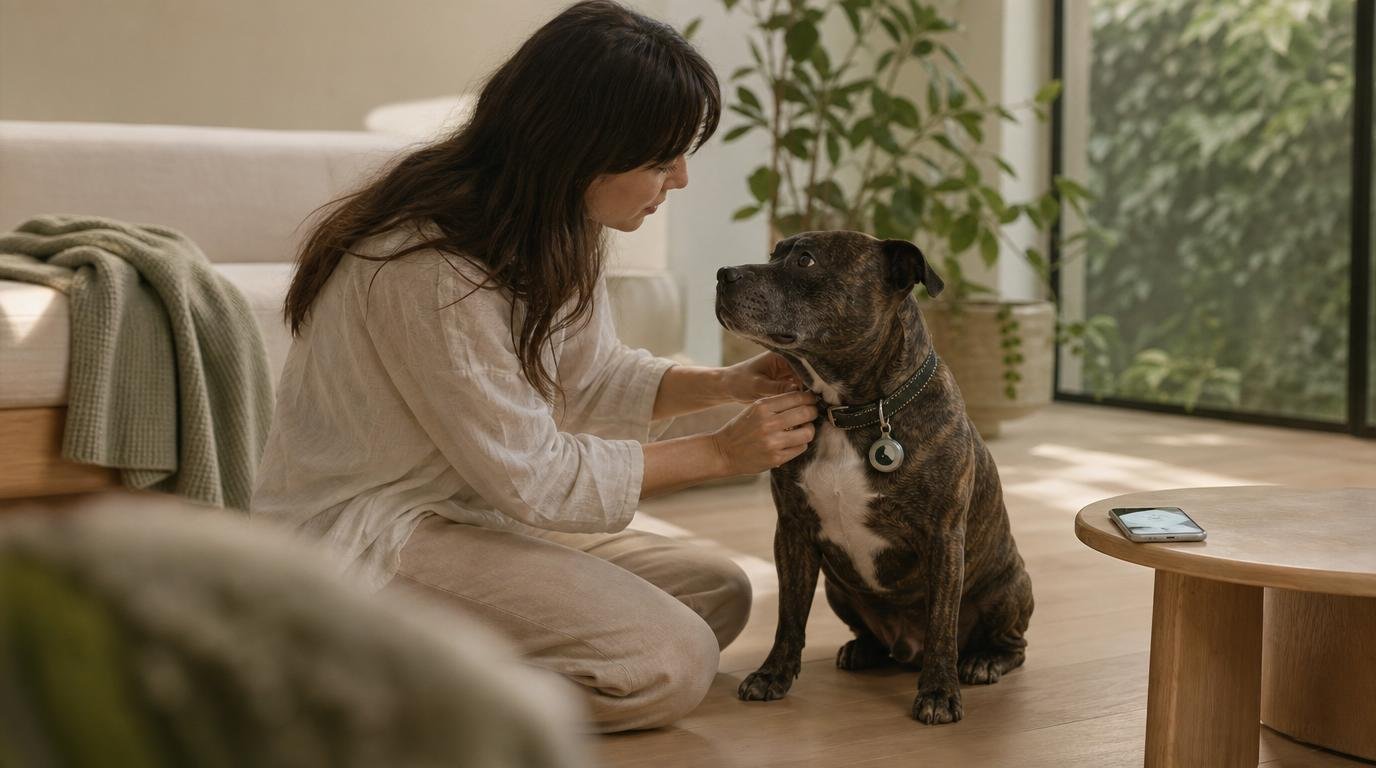
DOGCan I Use Apple AirTags as a GPS Collar for My Dog? Ultimate Guide for Australians
AirTags are cheap and clever, but they're not a real GPS collar. Here's where they help, where they fall short, and what to use instead.

 DOG
DOGUltimate Guide to the Best Dog GPS Collars in Australia with a Subscription
Live tracking that follows your dog anywhere — for a monthly fee. We found the most accurate, reliable subscription GPS collars.
 DOG
DOGDo Dog GPS Trackers Actually Work? Pros, Cons & Limitations (Ultimate Aussie Guide)
GPS trackers promise peace of mind — but do they deliver? We unpack the accuracy, the limits and whether they're worth it.
