Dogs | Accessories | Grooming
Best Dog Grooming Rakes in Australia: Ultimate Aussie Guide for 2026
If you live in Australia, your dog’s coat cops it: heat, humidity, grass seeds, beach sand, and that “why is there fur on the ceiling?” seasonal shed. Fun fact: double-coated dogs don’t just shed more — that loose undercoat can trap heat and turn into mats if it’s left to compact, especially after a swim or a humid walk. Bruce (my Golden Retriever) can become a fluffy tumbleweed in about five minutes flat. A slicker brush is brilliant for the surface layer — it teases out light tangles and fluffs the coat — but a grooming rake is what actually reaches down into the undercoat to pull out the loose stuff that causes that “packed” feeling. Get the right rake and you’re looking at a calm five-minute tidy-up… get the wrong one and you’re signing up for a sweaty, furry wrestling match. Let’s make this the easy version.
Best Overall

Maxpower Planet Pet Double Sided Undercoat Rake
- Dual-sided: detangle then de-shed
- For thick, long, double coats
- Not for short coats
Best for Long Coats

GENPEPADO Dematting Brush for Dogs
- Extra-long teeth reach deep tangles
- Compact size is easier to control
- Not for daily light grooming
Best for Thick Coats
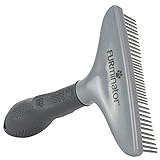
FURminator Grooming Rake for Dogs
- Rotating teeth lift loose undercoat
- Built for dense double coats
- Some dogs need a slow intro
Best Gentle Daily Rake

JW Gripsoft Double Row Undercoat Rake
- Round-tipped pins, gentle on skin
- Non-slip grip for controlled work
- Not for short single coats

All four picks above do the same job — lift loose undercoat — but they do it on different coat types and at different intensities. Below: the five details we look at when choosing between them, then a head-to-head comparison and our full notes on each rake.
What to look for in a dog grooming rake
Five details that change how well a rake fits your dog and your routine. Scroll across to read all five.
Coat type first
Start with your dog’s coat. Single-row rakes feel gentler and are easier to control; dual-sided and double-row tools work faster on dense double coats, but only earn their keep if you’ll use both sides.
Rake vs brush
A rake reaches into the undercoat to lift loose fur. A pin brush or slicker finishes the surface. Skip one and you’ll over-rake or under-groom — they’re meant to work together.
Grip and pressure
A non-slip handle that doesn’t twist matters more than tooth count. Use light pressure and short strokes, especially around legs, armpits, and loose skin. Tired hands turn into sloppy technique fast.
Aussie conditions
Heat and humidity speed up undercoat compaction, so groom more often in short sessions through summer. Store metal tools dry between uses — they’ll quietly rust if left near a damp bathroom.
Real-life costs
Beyond the price tag, factor in the clean-up: rakes don’t capture shed fur, so groom outside or over an old towel. A finishing brush helps if you want the coat smooth afterwards.
At a glance
Our top four picks compared — specs, prices, and our one-line take on each.
| Rank | Product | Best for | Key feature | Approx. price | Check price link |
|---|---|---|---|---|---|
| Best Overall |  | Thick or double coats needing regular undercoat lift | Dual-sided design — 9 teeth for tangles, 17 for de-shedding. | ~$15–$25 AUD | Check price |
| Best for Long Coats |  | Long coats with tangles in friction zones | Extra-long teeth reach mats under longer topcoats. | ~$11–$21 AUD | Check price |
| Best for Thick Coats |  | Dense double coats (husky-type, fluffy mixes) | Rotating metal teeth glide through dense undercoat sections. | ~$25–$35 AUD | Check price |
| Best Gentle Daily Rake |  | Medium-to-long and double coats needing daily maintenance | Double row of round-tipped pins for gentle, regular use. | ~$20–$25 AUD | Check price |
Our picks in detail
What we love, what to watch out for, and who each pick really suits.
Best Overall: Maxpower Planet Pet Double Sided Shedding and Dematting Undercoat Rake
Bottom line — the all-purpose rake for thick or double coats, with a dual-sided head that handles detangling first, then de-shedding, in one tool.
This is the “get it done” rake for thick coats, especially double-coated dogs that trap undercoat like it’s their full-time job. The dual-sided setup (9 teeth for tackling mats and tangles, 17 teeth for thinning and de-shedding) is genuinely practical: you can start with the more “problem-solving” side, then switch to the side that pulls out loose undercoat and leaves the coat feeling lighter.
In sticky coastal humidity (or after a muddy bush track), that two-step approach helps stop loose undercoat from compacting into bigger knots.
The big watch-out is technique. Because it’s a metal-tooth tool designed to remove tangles and undercoat, it’s not something you drag hard across skin. Use minimal pressure, short strokes, and stay away from sensitive areas like legs and joints. It also isn’t intended for short-coated dogs or short-haired cats, so think of it as a specialist for longer, thicker coats.
| What we love | Areas for improvement |
|---|---|
|
|
Best for Long Coats: GENPEPADO Dematting Brush for Dogs
Bottom line — a targeted dematting tool for long coats that get tangled in friction zones, best used in careful, small sections rather than as a daily rake.
This one is all about reach and control. Its standout point is the extra-long teeth, which (when used carefully) can get through longer topcoat layers to the knotty bits underneath. That matters for dogs who grow feathering and “pants” fur, or who get that sneaky under-layer tangling around collars, harness lines, behind the ears and along the tail. In practical terms, it’s a targeted tool for problem spots rather than a whole-body daily rake.
Because this is a dematting-style brush, the safety/comfort side comes down to patience: work in tiny sections, support the hair near the skin with your fingers, and stop if you feel resistance that’s pulling.
If you’re unsure, your “lowest drama” approach is to break mats up slowly instead of trying to rip through them in one go (that’s how dogs learn to hate grooming forever). The hidden “cost” is time: you’ll likely follow it with a gentler brush to smooth the coat and remove loosened fluff.
| What we love | Areas for improvement |
|---|---|
|
|
Best for Thick Coats: FURminator Grooming Rake
Bottom line — the dense-undercoat specialist, with rotating teeth that lift packed fur with less snagging, particularly useful in Aussie humidity.
If your dog has that classic dense double coat that seems to “hold onto” loose fur (hello, winter undercoat lingering well into spring), the rotating metal teeth are the main appeal here. The rotating design can help the rake move through coat sections with less snagging, lifting loose undercoat rather than catching and yanking. That’s particularly helpful in Aussie humidity, where loose undercoat can clump and felt if it sits too long.
Comfort-wise, the non-slip ergonomic handle matters more than people think. If your hand gets tired, technique gets sloppy, and that’s when dogs start reacting.
This rake is pitched as an undercoat care tool for thick fur and dense double coats, so it’s best used as part of a routine: quick, gentle sessions that remove loose fluff before it turns into tangles. There aren’t ongoing consumables, but it’s still worth pairing with a regular brush (especially for finishing) so you’re not over-raking just to get that “smooth coat” look.
| What we love | Areas for improvement |
|---|---|
|
|
Best Gentle Daily Rake: JW Gripsoft Double Row Undercoat Rake
Bottom line — the everyday maintenance pick for medium-to-long and double coats, with round-tipped pins that keep regular short sessions gentle and predictable.
If you want a rake that earns its place in the weekly grooming routine rather than sitting in the drawer until a mat crisis, this is the pick. The double row of round-tipped stainless steel teeth is designed to do two things at once: loosen lightly matted sections and lift dead, shedding hair out from the undercoat. Round tips matter — there are no cutting edges or blades involved, which keeps the feel predictable and gentle, particularly on dogs who are still building tolerance to grooming tools.
The non-slip rubber-sheathed handle is a practical detail that pays off in Aussie conditions: humid hands after an outdoor session, a wriggly Staffy, or a quick post-beach tidy-up all benefit from a grip that doesn’t twist. It works well on medium-to-long coats and double coats — exactly the dogs that accumulate undercoat fastest in our climate.
The one limitation to keep in mind is that this rake is a maintenance tool, not a rescue tool — if a tangle has progressed to a tight mat, you’ll want a dematting comb first before reaching for this. Used before that stage, though, it keeps undercoat moving and stops the “packed” feeling that builds up between proper grooms. Like the single-row Coastal Pet option it replaces in a lot of grooming kits, it won’t trap shed hair as it rakes, so groom outside or over an old towel if you’d rather not find fur in your coffee.
| What we love | Areas for improvement |
|---|---|
|
|
FAQ
How often should I use an undercoat rake?
Can a rake replace a normal brush?
What should I do if my dog has painful mats?
Are shedding blades safe for all dogs?
My dog hates grooming tools. How do I make this less dramatic?
Final thoughts
There’s no one-size-fits-all rake — the best choice depends on your dog’s coat, comfort level, and how you actually groom at home. Dense double coats usually need something that can lift packed undercoat efficiently, while long or flowing coats benefit from more targeted detangling without dragging. For sensitive dogs, control and a gentler feel matter more than speed. Keep sessions short, use light pressure, and groom little and often rather than saving it all for a big clean-out — especially in Aussie heat. When grooming stays calm and predictable, coats stay healthier and shedding stops taking over your house.
We Think You’ll Also Like These Guides
 DOG
DOGBest Dog Grooming Clippers Reviewed: Ultimate Australian Owners Guide
At-home clipping saves money and stress — with the right tool. We tested the best clippers for quiet power and every coat type.

 DOG
DOGBest Dog Grooming Vacuums in Australia: Ultimate 2026 Owners Guide
Catch the fur before it hits the floor. We tested the quietest, most powerful grooming vacuums for tidy at-home sessions.
 DOG
DOGThe Best Dog Hair Dryers in Australia for Dog Grooming: Ultimate At-home Guide
A proper dog dryer beats a towel — and your hairdryer. We found the best for fast, gentle drying without the burn risk.